


The market has shifted. Budgets remain under pressure, customers are scrutinising every technology investment, and spending is increasingly being directed toward initiatives that deliver measurable business outcomes. At the same time, AI is accelerating the pace of change and taking an unfair share of the budget, while cybersecurity threats continue to evolve, and customer expectations continue to rise.
Yet despite the uncertainty, opportunity remains strong. The partners growing fastest are those adapting to changing customer priorities, building new capabilities, and helping customers navigate an increasingly complex technology landscape.
For the first time, the partner opportunity within the SMB market exceeds that of enterprise. SMBs are investing across every technology segment and are increasingly seeking partners who can help them improve productivity, strengthen security, enable innovation and translate technology investments into measurable business outcomes.
Against this backdrop, Ben Johnson, General Manager, Marketing & Strategy, shared Dicker Data’s vision for the distributor of the future:
"To become the Copilot of every partner."
This vision reflects our commitment to helping partners identify new opportunities, build capability, and navigate the forces reshaping the technology industry.
"At TechX 2026, more than 5,000 partners, vendors and industry leaders joined us across five locations to explore the trends shaping Australia's technology landscape and where the greatest growth opportunities exist for the channel," Vlad Mitnovetski, Executive Director and COO at Dicker Data.
The Market Outlook: Where Partners Should Be Investing
Mark Iles, Chief Analyst at Omdia, shared his perspective on the market trends, investment priorities and opportunities expected to shape partner growth in FY27.
Mark’s message for partners was clear: customer priorities may be evolving, but investment remains strong in the areas that improve resilience, enable innovation and deliver measurable business outcomes.
Customer investment continues to focus on three priorities:
-
Modernising applications and infrastructure
-
Improving cybersecurity and reducing risk
-
Enabling business innovation and agility
Looking ahead to FY27, Omdia identified five solution areas expected to drive partner growth:
-
Managed Services
-
Cybersecurity
-
AI solutions and services
-
Business consulting services
-
Networking, UC and telecommunications
Importantly, the role of the partner is also evolving. As Mark Iles highlighted, the market is shifting from being simply "channel sold" to increasingly partner assisted, creating new opportunities for partners that can combine technical expertise with strategic guidance.
The global AI partner services opportunity is expected to reach $267 billion by 2030, demonstrating the demand for partners services that can help customers navigate not only technology adoption, but also security, governance integration and business transformation ROI.
Mark also identified six Australian industries expected to generate significant technology spending and new partner opportunities in FY27.
-
Healthcare
-
Transport, logistics
-
Finance & Insurance
-
Rental, real estate
-
Professional services
-
Construction
Four Strategic Pillars Where Partners Can Drive Growth in 2027
Based on market trends, customer demand and the opportunities we see emerging across our partner ecosystem, there are four forces that will shape the successful partner in the years ahead.
1. Edge intelligence is redefining where modern workloads run
As organisations prepare for an AI-infused future, they're rethinking the foundations required to support modern workloads. Intelligence is no longer confined to the cloud or the datacentre. It's increasingly being distributed across the network to the edge and the device itself, creating new opportunities for partners to help customers modernise their technology environments to meet where technology is headed tomorrow.
Did you know, more than 3 million Windows 11 commercial devices in Australia are now over four years old? And in addition, 500,000 Windows 10 commercial devices still need upgrading?
Copilot+ PCs now represent 20% of all PCs sold, creating a significant opportunity for partners to drive AI-readiness conversations.
The key to AI readiness is starting with the right foundation. With intelligence moving beyond the cloud and onto devices, every device conversation becomes an opportunity to discuss productivity, security and AI adoption, underpinned by modern AI-enabled devices.
"Every device refresh is now a conversation about productivity, security and AI readiness. The opportunity for partners is much bigger than replacing hardware. A new PC refresh cycle is underway, creating opportunities to modernise devices, drive Copilot adoption and unlock new customer conversations.” - Gary Lawrence, Microsoft Business Development Manager, Dicker Data.
We recommend: Leverage our Windows 11 Readiness Tool, our new Device Age Tool and Microsoft's 30-day Copilot trial to identify opportunities within your existing customer base. Interested in the 30-day Copilot trial? Contact our Microsoft team for access.
2. Acceleration of Cybersecurity
Cyber resilience is non-negotiable.
As AI adoption accelerates, so does the sophistication of cyber threats. Customers are facing an expanding attack surface across devices, networks, cloud environments and data, increasing the need for a layered approach to cybersecurity.
GTIA research shared during TechX 2026 found that only 15% of partners sell more than five cybersecurity vendors. That’s because no single vendor owns the whole cybersecurity journey nor can a single vendor solve the entire cybersecurity challenge. Cybersecurity is a team sport. It’s an ecosystem play.
"Customers need confidence that every layer of their environment is protected. That's where partners can create the greatest value." - Tony Lam, Head of Strategic Software Sales & Alliances, Dicker Data.
Attackers don't target a single layer. They look for the weakest link in the chain:
User → Identity → Email → Endpoint → Network → Cloud → Data → Backup.
“We offer presales technical support, opportunity scoping, demos, proof of concepts and support to help MSPs get setup and deploying best practice cybersecurity solutions. Additionally, we provide access to a diverse range of vendors covering various security and cyber resilience needs.” – Pennie Stevens, General Manager, Software, Dicker Data.
As AI increases the sophistication of cyber threats, customers are looking beyond individual security products and focusing on resilience across their entire environment.
We recommend: Adopt a trusted cybersecurity framework and use it to assess your customers' security posture across every layer of their environment. Identify gaps across email, identity, endpoint, network, cloud, data and backup, then prioritise remediation based on risk and business impact. Once visibility is established, build integrated cybersecurity solutions that strengthen resilience across the entire threat chain and leverage Dicker Data's specialist expertise, enablement services and security ecosystem to support delivery.
3. From Selling Seats to Selling Outcomes
Industry economics are redefining business models and customer expectations.
7.2 million Australians, representing approximately 50% of the workforce, are expected to be impacted by AI by 2030. Of those, 3.3 million roles will be augmented and 3.9 million roles will be disrupted.
For years, technology spend scaled with headcount growth. More employees in your customers equalled more devices, licences and endpoints. Today, customers are investing differently and headcount growth is slowing.
AI is accelerating demand for productivity frameworks supported by modern infrastructure, automation, governance, security and devices. The conversation is shifting from technology consumption to business outcomes and business impact.
For partners, this creates an opportunity to build new consulting, automation and outcome-based service offerings.
"The question isn't how many licences your customer needs. It's how much productivity and value you can help them unlock. Consider how you price for AI outcomes, workflows and automation in the future. We need to shift to outcome-based billing. How will you commercialise an outcome instead of a seat?" - Ben Johnson, Marketing & Strategy, General Manager, Dicker Data.
At the same time, the AI skills gap is becoming a growth gap. Partners investing in learning, capability development and practical AI experience today will be best positioned to support customers tomorrow.
We recommend: Review how your services are packaged, priced and measured. Consider how you can commercialise automation, consulting and business outcomes, rather than simply technology consumption, while continuing to invest in the skills and capabilities needed to support the next wave of customer demand.
We recently launched Dicker Data Academy to help partners turn knowledge into a competitive advantage through structured learning, certifications, technical enablement, and hands-on training across AI, cloud, and cybersecurity. Explore the Academy and start building the skills that will drive your future growth.
4. The AI Opportunity
The global AI partner services opportunity is expected to reach $267 billion by 2030.The market is beginning to distinguish between AI capability and AI-derived business outcomes. As customers move beyond experimentation, they're increasingly looking for partners that can help them deploy AI securely, govern it effectively, and integrate it into existing business processes. Success will increasingly be defined by the ability to deliver business value, not just technology.
"As AI becomes commoditised, success won't be defined by access to a model. It will be defined by your ability to deliver business outcomes." - Amir Kalil, AI Practice Lead, Dicker Data.
The models that underpin AI are now commoditised, and access is no longer guaranteed. Whilst this presents risks for partners, it is also creating a wave of opportunity for those who can build the secure and compliant foundations required to deliver tangible ROI outcomes against your customers’ AI investments.
If you’ve ever had a customer suggest “we need some AI”, you’d be familiar with the uncertainty and pressure that statement shifts onto your business. What your customer is asking for is a framework enabling them to leverage AI in their business, and it looks like this:
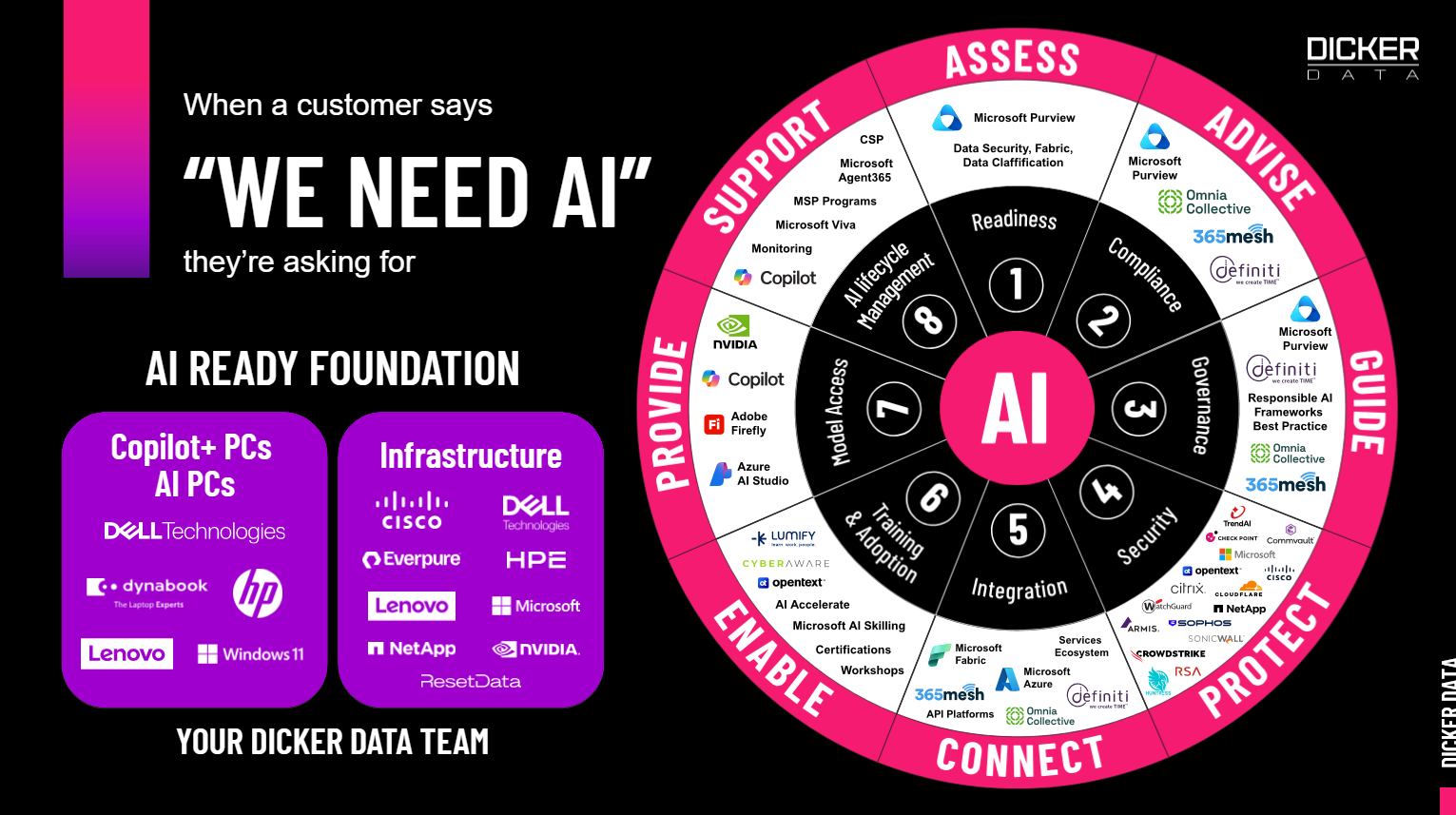
To help partners navigate this opportunity, Dicker Data has developed an AI Framework built around these eight critical pillars, supported by a specialised local team and an extensive portfolio of vendors aligned to each stage of the AI journey.
-
Readiness
-
Compliance
-
Governance
-
Security
-
Integration
-
Training & Adoption
-
Model Access
-
AI Lifecycle Management
Dicker Data’s extensive portfolio of world leading vendors aligned to each of the 8 pillars, and specialised local teams who can support you across every aspect are critical to delivering secure, compliant AI outcomes.
The future of AI will be hybrid and sovereign, creating new opportunities for partners to guide customers on architecture, security, data strategy, and long-term adoption.
“As AI adoption accelerates, sovereignty is becoming a critical consideration. Just as we saw with the initial shift to the cloud, the future isn't one-size-fits-all. It's hybrid, giving organisations greater choice, flexibility and control." - Ben Johnson, Marketing & Strategy, General Manager, Dicker Data.
The best place to start is with your own business. Understanding the frameworks, opportunities, and challenges firsthand will put you in a stronger position to support your customers' AI journey.
Current state of AI:
-
Models are commoditised: frontier-grade capability is now accessible, open and interchangeable. The model itself is no longer the moat.
-
Access isn’t guaranteed: as businesses become increasingly reliant on AI, ensuring continuity of access to the technology is critical.
-
Just as cloud moved to consumption models, AI is accelerating the shift from fixed pricing to pay-as-you-go capabilities.
Beyond the AI Framework, Dicker Data has several initiatives designed to help partners develop skills, assess readiness and explore practical AI use cases.
We recommend: Begin with our AI Readiness Assessment to benchmark your AI maturity and identify areas for improvement. From there, use the AI Framework's eight pillars to assess readiness, governance, security, integration and adoption requirements, creating a clear roadmap for delivering AI outcomes for both your business and your customers. Dicker Data's local AI specialists can help you navigate each stage of the journey.
Ready to Turn Opportunity into Growth?
The opportunities ahead are significant, but success will depend on having the right strategy, capability and support.
Now is the time to lean into your distribution partner. Whether it's identifying new opportunities, designing the right solution, building capability within your business or helping you close the deal, our team is here to support you every step of the way, no matter how complex the opportunity.
Backed by our people, expertise and ever-growing vendor ecosystem, we help partners navigate change with confidence and turn emerging opportunities into sustainable growth.
Speak with your Dicker Data representative about the tools, expertise and programs available to help accelerate your success. Or reach out to our team here.
Discover why Experience is the Difference

Four Strategic Moves IT Partners Can Make to Drive Growth Heading into 2027

Your Gear Works Better Here: Why NetApp and Equinix Are Stronger Together