If you've run co-op before, FY27 will feel familiar in shape but somewhat easier in practice. The changes fall into two buckets: how the program is structured, and how you claim.
What's changed in the program
More weight on demand generation. Microsoft has provided guidance on how it would like partners to invest co-op. This is guidance only (not enforced) but Microsoft would like to see partners direct 50% of co-op to Demand Generation, 40% to Market Development and 10% to Partner Capability. From a Solution Area point of view, 30% to Copilot, 30% to Cloud & AI and rest across remaining categories.
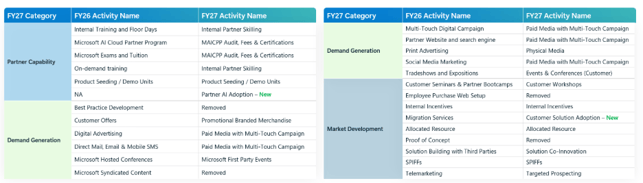
Updated activity list. Microsoft has removed overlapping activities, making the list more prescriptive and reducing guesswork around what qualifies. Removed categories include Best Practice Development, Microsoft Syndicated Content, Employee Purchase Web Set-up and Proof of Concept, while new categories include Partner AI Adoption and Customer Solution Adoption, which replaces Migration Services.
Here’s a full view of the category changes:
Caps and cost guidance broadened: Enforceable spend caps now sit at the activity level: Spend on Allocated Resources remains capped at 50% (although Microsoft has advised this will decrease in FY28), Partner AI Adoption at 5%, Customer Solution Adoption at 5%, Internal Incentives and SPIFFs at 2% and Promotional Branded Merchandise at 1%.
Allocated Resources funding limits: Microsoft will now cap funding per resource, with AU and NZ monthly limits set at US $17K for Sales, US $20K for Marketing and US $27K for Technical roles, which are quite generous for our market.
Training is now part of the requirements. Microsoft-dedicated Sales, Technical and Marketing resources can still be claimed under Allocated Resources, but they must now complete the required training within three months.
AI gets its own activity. Partner AI Adoption is a new category. This funding is intended to help you build internal AI agents and put AI to work across your own business. This is a positive new inclusion which reinforces Microsoft’s commitment to help partners become customer zero for AI.
Paid social is no longer optional for Multi-Touch Campaigns. All previous digital marketing categories of have been collapsed into one category called Paid Media with Multi-touch Campaign – which has a mandatory requirement for paid media activity. This change will limit partner’s ability to claim digital programs with no paid media component eg. Email marketing and website costs.
Event travel claim changes are also worth noting and sees some positive changes. For Internal and Reseller Skilling events, external trainer travel is still eligible but capped at US $5K/ $45K per year; for customer Events (Customer) and Conferences and Customer Workshops, partner speaker travel is now also eligible; and Microsoft First-Party Events has increased to allow up to 6 partner attendees (up from 3) for global events and 3 for regional events.
What's changed in claiming
The theme here is simple: less creative paperwork, more clarity.
- A detailed third-party invoice is now sufficient for Proof of Execution, provided it shows the what, when and where — creative pieces are no longer required for invoices that meet this criteris.
- When using CSR forms, each expense type gets its own line on the CSR form instead of everything bundled together.
- Every POE should tell the full story: what, when, why and how.
- Real deliverable examples are now provided for Allocated Resources, so you're not guessing at the standard.
- One submission per activity replaces multiple submissions.
- Random POE audits are being introduced to protect program integrity for everyone.
- Partner Center has richer co-op detail and a built-in agent to help you along the way.
The bottom line
FY27 co-op asks for sharper focus — on demand generation, on AI, on well-evidenced claims — and gives back a simpler, more predictable process in return. Fewer overlapping activities, clearer caps, and a claim form that finally matches how you actually spend.
For more information, review the full Microsoft FY27 Co-op Policy Guide or reach out to our Dicker Data Microsoft marketing team.

Microsoft Momentum October 2026 Edition - AI Innovation, Marketplace Growth and New Opportunities Ahead

The New Copilot: Your Opportunity As A Partner

Microsoft Momentum August 2026 Edition: Customer Growth, AI Adoption and Why FY27 Is Different

Microsoft Momentum July Update: FY27 Indirect Reseller Changes